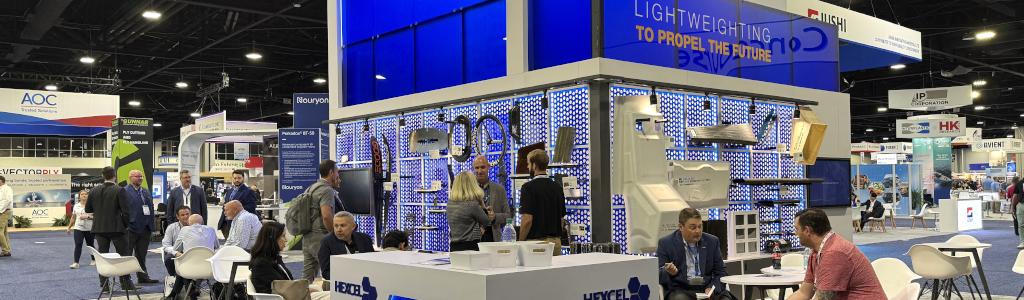

Hexcel arrived at the 2026 Composites and Advanced Materials Expo (CAMX) in Atlanta, Georgia focused on two priorities that are increasingly shaping the aerospace industry. The company highlighted its work supporting rising production rates across commercial aerospace while continuing to invest in the materials, technologies and manufacturing capabilities needed for future aircraft, defense systems and space platforms.
Throughout the show, Hexcel’s booth served as a hub for customer engagement, with company representatives conducting meetings from early morning through evening with customers, suppliers, and industry partners.

“You could feel the energy at this show,” said Marc Gomez, Director, Customer Business Teams.” We had customers in the booth from the minute the floor opened until it closed every day, and the conversations were remarkably consistent. People are worried about how the industry is going to sustain the production ramp, but they’re also thinking about what’s next. They’re looking at future aircraft applications, and how Hexcel can deliver. It was great to have the opportunity to connect with our customers, no doubt about it.”
While discussions centered on meeting commercial aerospace production ramp challenges and how Hexcel’s advanced materials can be used across commercial aerospace, defense and space markets, the company also made several product development announcements during the show.
Hexcel announced the industry’s first NCAMP-qualified honeycomb core material, HRH-10, introduced a new vented version of its Flex-Core® metallic honeycomb for space launch applications and highlighted the continued rollout of its HexPly® M901 fast-cure prepreg system, which is now produced in the United States.
“Right now, our number one priority is supporting the rate ramp in commercial aerospace,” said Imad Atallah, Vice President, Aerospace Commercial Growth and Product Management for Fibers, Matrix and Reinforcements. “That’s where we spend most of our time. At the same time, we’re investing in capacity, automation and new material technologies because our customers need solutions not only for today’s aircraft programs but also for the next generation platforms.”
The NCAMP qualification of HRH-10 marks a significant industry milestone. The qualification establishes a shared database and certification framework for one of aerospace’s most widely used honeycomb materials. By providing readily available qualification data, the program can help aircraft manufacturers reduce development time and costs when incorporating the material into new applications.
The company also introduced a vented version of its Flex-Core metallic honeycomb product. The technology is designed primarily for space launch applications, where pressure differentials can create challenges for conventional honeycomb structures. By allowing pressure to dissipate through perforated cell walls, the vented configuration can help support launch vehicle and spacecraft structures exposed to extreme environments.

Hexcel’s third announcement focused on HexPly M901, a fast-cure prepreg system developed to support high-rate manufacturing environments. The material can achieve cure cycles measured in minutes rather than hours, making it attractive for applications where production speed and automation are becoming increasingly important. This material has a long track record of successful production in Europe, but it is now qualified for manufacture in Salt Lake City, expanding U.S. production capability.
Supply chain resilience emerged as another key topic throughout the week. In discussions with industry media, Atallah said customers are placing greater emphasis on domestic manufacturing capabilities and supply chain transparency, particularly for defense and space applications. He noted that Hexcel’s vertically integrated footprint provides the ability to manufacture carbon fiber, reinforcements, prepregs and other advanced composite materials within both the United States and Europe.
“We’re seeing customers ask more questions about where materials are made and where critical inputs come from,” Atallah said. “Whether it’s commercial aerospace, defense or space, they want reliable supply chains and trusted manufacturing partners. That’s one of the strengths of our business. We can support those requirements through an integrated manufacturing footprint in both the U.S. and Europe.”

The future of aerospace composites was also addressed during a CAMX presentation by Michael Gleason, Director of Product Management, Matrix & Composite Materials. Gleason explained how Hexcel’s long-standing strategy of vertical integration has enabled the company to support major increases in composite adoption across aerospace markets while providing customers with greater supply chain reliability and scalability.
According to Gleason, the same strategy that helped support previous generations of commercial aircraft will be equally important as the industry prepares for future platforms that demand higher production rates and faster innovation cycles. He highlighted investments in research and development, manufacturing centers of excellence and customer support capabilities designed to help accelerate material adoption.
“Having innovative materials is important, but it isn’t enough on its own,” Gleason said. “We have to help customers qualify those materials faster, scale them into production and reduce risk along the way. That’s why we’ve invested in everything from our research and technology center of excellence in Salt Lake City to qualification programs like NCAMP and new application development capabilities. The goal is to help customers get the next generation of aerospace products to market more quickly.”
Gleason also echoed how Hexcel’s vertically integrated business model is a key differentiator as aerospace manufacturers prepare for future programs.
“The benefit of vertical integration is that it allows us to connect material development, manufacturing and customer support in a way that creates value for customers,” Gleason said. “As new aerospace programs come online, that combination of innovation, scalability and supply chain control becomes increasingly important.”
Together, Hexcel’s product announcements, booth engagement, customer meetings, panel participation and technical presentations reinforced a clear message that Hexcel is ready to meet its production commitments while helping advance the next generation of aerospace innovation.
“CAMX provided a valuable platform to connect with the broader composites community and highlight the innovations that are advancing our industry,” said Atallah. “We appreciated the strong interest in Hexcel’s technologies and look forward to building on the discussions at the show.”